Boundaries and interior spaces tell mathematical stories about shapes. Young geometers work with perimeter and area free grade 5 practice questions that explore measuring around edges and calculating internal space through hands-on activities. These fundamental exercises connect abstract concepts to playground measurements, room planning, and garden design projects. Students can download free Class 5 perimeter and area printable worksheet PDF, each calculation builds spatial reasoning and practical application skills.
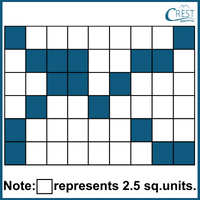
1. What is the area of the shaded figure ?
a) 42.25 sq. units
b) 42.50 sq. units
c) 42.75 sq. units
d) 52.25 sq. units
Answer: b) 42.50 sq. units
Explanation: Total number of shaded squares = 17
Area of 1 square = 2.5 sq. units
Therefore, area of shaded figure = 17 × 2.5 = 42.50 sq. units
2.The length of a rectangle is 7 m more than its width. If the perimeter of the rectangle is 50 m, what is its area?
a) 96 m2
b) 104 m2
c) 144 m2
d) 128 m2
Answer: c) 144 m2
Explanation: Let's denote the width of the rectangle as x m.
Therefore, the length is x + 7 m.
The formula for the perimeter of a rectangle is 2 x (length + width).
Perimeter of a rectangle = 2 (x + 7 + x) = 50
2 (x + 7 + x) = 50
2x + 7 = 25
2x = 18
x = 9
Therefore, Length = 9 + 7 = 16 m
Width = 9 m
Area of rectangle = Length x Width = 16 x 9 = 144 m2
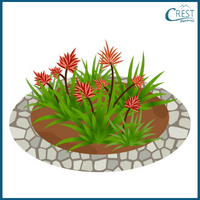
3. What is the area of a circular flower bed of diameter 5.6 metres?
[Take π = 22/7]
a) 24 m²
b) 24 m²
c) 64 m²
d) 84 m²
Answer: c) 24.64 m²
Explanation: Diameter = 5.6 m
Radius = Diameter/2
= 5.6/2 = 2.8 m
Area of a circle = π × Radius × Radius [π = 22/7]
= 22/7 × 2.8 × 2.8
= 22/7 × 28/10 × 28/10
= 24.64 m²
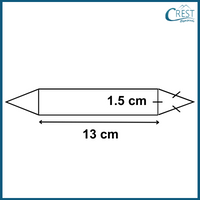
4. Two triangles with equal sides and a rectangle form the given figure. What is the perimeter of the entire figure?
a) 30 cm
b) 32 cm
c) 33 cm
d) 35 cm
Answer: b) 32 cm
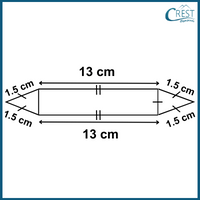
Explanation: The labelled figure is:
Perimeter of the figure = (13 + 1.5 + 1.5 + 13 + 1.5 + 1.5) cm = 32 cm
5. A rectangular swimming pool measures 25 meters in length and 10 meters in width. If one square tile covers an area of 0.25 square meters, how many tiles are required to cover the bottom of the pool?
a) 100
b) 500
c) 1000
d) 250
Answer: c) 1000
Explanation: Area of the rectangular pool = length x breadth
= 25 m × 10 m
= 250 m2
Area of square tile = 0.25 m2
Number of tiles = Area of the rectangular pool/Area of square tile
= 2500.25
= 25025 x 100
= 1000
Hence, 1000 tiles are required to cover the bottom of the pool.
>> Join CREST Olympiads WhatsApp Channel for latest updates.
The worksheet PDF is not available at this time.
>> Join CREST Olympiads WhatsApp Channel for latest updates.
In this section, you will find interesting and well-explained topic-wise video summary of the topic, perfect for quick revision before your Olympiad exams.
>> Join CREST Olympiads WhatsApp Channel for latest updates.
Take a FREE Olympiad Practice Test — Classes Nursery to 10
Start Free Practice TestStudents from 6000+ schools • 60+ countries