Set your child up for success in the Science Olympiad with this thoughtfully designed Class 4 sample paper. Created to match the learning level of Grade 4 students, it gives a clear idea of the question pattern while making science learning more engaging and purposeful.
What's Included in the Sample Paper?
Carefully designed multiple-choice questions covering important science concepts from the syllabus.
Divided into two sections: Practical Science and the Achiever's Section to challenge advanced learners.
Includes a detailed answer key with clear explanations to help children learn and revise independently.
Download the Class 4 Science Olympiad Sample Paper (PDF)
Download the free Science Olympiad Sample Paper for Class 4 in PDF format, to help your child practise effectively, build confidence, and perform their best in the Olympiad exam.
Matter exists in three states. Which of the following figures shows the arrangement of particles in a solid state?
Q.2
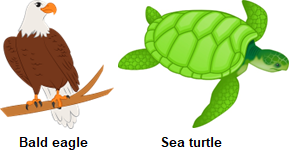
What is common between the two animals shown below?
Q.3
State the effect of the force in each of the following cases:
James blows the air from his mouth on the smoke rising up from a burning stick.
When we sit on a sofa with springs, then the springs of the sofa get compressed.
Q.4
Consider the following statements and choose the correct option:
Statement 1: A man cuts down the trees and modifies his environment to make life comfortable. By deforestation, he clears the land for agriculture, industries and habitat.
Statement 2: Plants and animals are interdependent. The decay of dead plants and animals provides nutrition to the soil which in turn help in the growth of plants and trees.
Q.5
Given below are a set of phenomena: 1. Tearing of paper 2. Souring of milk 3. Chopping of wood 4. Breaking a glass
Which of the above changes can be reversed?
Q.6
Fill in the blank with the correct option:
Jane loves to play outside in the sun all the time with her friends. Exposure to sunlight is a natural way of getting ___________________.
Q.7
Choose the correct option and complete the following sentence:
The bile is secreted by ___________. It is stored in __________. It helps in the breakdown of _________.
Q.8
In reference to the different types of forces acting on various objects, which of these is INCORRECTLY paired?
Q.9
Choose the correct option and complete the sentence given below: When harmful substances mix with air and make it dirty, it is called air pollution. Air pollution does not cause __________________________.
Q.10
Two students were having a class discussion about friction. This is what they said: Michael: The force of friction between the tyres of a vehicle and the road helps the vehicle to stop when the brake is applied. Ron: It is possible to write on a glazed paper if there is no friction.
Who among the above students was wrong?
Your Score: 0/10
Every champion starts somewhere 💪
You scored , and that's a great start! Mistakes are how we learn. Here's how to get stronger: